
If you’re selling a home in the Portland area right now, there’s a decent chance you’re going to have a conversation with your Realtor about reducing the price at some point. That’s not me being negative. That’s just the reality of selling in a market where buyers have choices, homes aren’t flying off the shelves in 48 hours, and slapping a ridiculous number on the listing because your neighbor’s house sold for that much three years ago isn’t exactly a bulletproof pricing strategy.
And if you start too high? Well, congratulations. You’ve dramatically increased the odds that we’ll eventually be having the “So…about the price” conversation.
Price reductions aren’t necessarily a sign that something is wrong with a house. Sometimes they’re simply the market correcting an overly optimistic starting price. Sometimes market conditions shift. Sometimes the seller wanted to test the waters (a terrible strategy in any market!). Sometimes everybody involved genuinely thought the price was right and the buyers collectively responded with, “Yeah…no.”
But here’s where sellers tend to make things worse.
Death By a Thousand Price Cuts
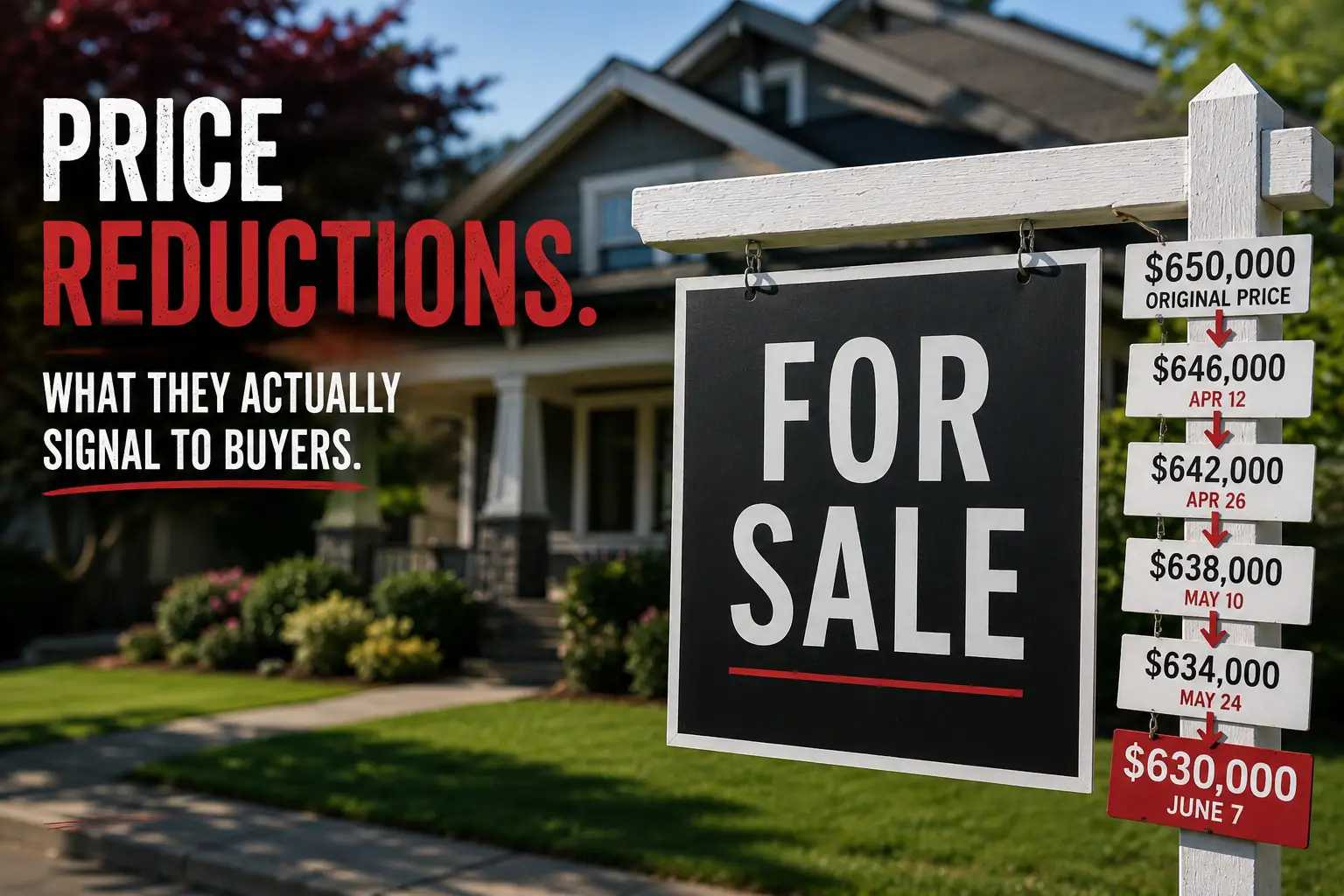
One of the most common strategies I see is the tiny incremental price reduction.
A house is listed at $650,000 and isn’t getting any action, so the seller reduces it to $646,000.
Ohhhhh shit. Four thousand dollars?! Everybody get in the fucking car!
Nobody who thought your house was overpriced at $650,000 suddenly wakes up at 2:00 in the morning screaming, “HONEY! THEY DROPPED IT TO $646K! PUT SOME PANTS ON!”
That’s not how buyers think.
A tiny reduction might technically generate an automated notification on some home-search websites, but that doesn’t mean it meaningfully changes the buyer’s perception of the property. More importantly, it probably doesn’t expose the house to a substantially different group of buyers either.
And that’s ultimately what we’re trying to accomplish.
Your Price Isn’t Just a Number. It’s a Search Filter.
This is the part sellers sometimes overlook. Buyers don’t usually search for homes priced from $0 to infinity. They establish ranges.
Maybe somebody’s looking up to $600,000. Maybe another buyer tops out at $650,000. Maybe somebody’s comfortable around $700,000 but doesn’t want to go much beyond that.
Those numbers create natural pricing thresholds.
So let’s say you’re listed at $675,000 and the market is telling us pretty clearly that we’re overpriced. Reducing the home to $669,000 might make the seller feel like they’re doing something, but we’re mostly showing the same house to the same damn people who already didn’t buy it.
Dropping to $649,900 is different.
Now we’ve crossed a meaningful search threshold. We’ve potentially entered searches for buyers capped at $650,000. We’ve changed the competitive set. And most importantly, we’ve given buyers a reason to reconsider the property.
That’s what a price reduction should actually do.
Buyers Are Watching You
Here’s the other thing sellers need to understand: buyers can see this shit.
They can see how long your house has been sitting there. They can see the price history. They can see when you listed at $700,000, dropped to $695,000, then $689,000, then $685,000, then $679,000.
And after a while, something interesting happens.
Instead of thinking, “Wow, this is becoming a great deal,” they start thinking, “How low are these guys willing to go?”
That’s a completely different psychological dynamic.
Now they’re not worried about somebody else buying your house. They’re sitting on the sidelines eating popcorn and watching the price slowly fall. It might be falling like a feather off a building, but it’s falling nonetheless.
And once buyers start smelling desperation, they’re not usually inspired to write stronger offers. They’re wondering how much further they can shove their hand (or other appendage) up your ass.
That’s not exactly the negotiating position we were hoping for.
Sometimes You Need to Rip the Band-Aid Off
If the market is clearly telling us the price is wrong, I’d rather make one meaningful adjustment than six bullshit ones.
Let’s say we’re listed at $625,000 and we’ve had limited showings, weak open-house traffic, no serious offers, and the comparable homes around us are selling closer to $590,000-$600,000.
Dropping to $619,000 probably isn’t fixing the problem.
We’re still overpriced.
Instead, maybe we go directly to $599,900.
Does that hurt?
Yeah. Probably.
Nobody enjoys hearing that their house is worth less than they hoped. Your home isn’t just an investment. You’ve lived there. You’ve improved it. You’ve probably spent an ungodly amount of money at Home Depot convincing yourself that replacing those cabinet pulls added $30,000 in equity.
I get it.
But the market doesn’t give a shit what we hoped the house would be worth.
Buyers determine market value through what they’re willing to pay.
The First Few Weeks Matter More Than Sellers Realize
When a home first hits the market, that’s usually when it gets the most attention. It’s new. Buyers haven’t seen it yet. Realtors haven’t toured it yet. It gets pushed into saved searches and alerts. There’s naturally more curiosity around a fresh listing. It’s the same reason why opening night of the new movie is super busy but in two weeks you can sit anywhere you want!
That’s your moment. If we waste that initial exposure by pricing the house way too high, we don’t get to magically recreate it six weeks later.
Sure, we can reduce the price and breathe some life back into the listing, but it’s not the same as launching at the right price from the beginning.
That’s why I generally don’t love the strategy of, “Let’s start high and see what happens.”
I can tell you what might happen.
We sit.
Then we reduce.
Then we sit some more.
Then we reduce again.
Eventually we reach the price we probably should have listed at in the first fucking place, except now the house has accumulated 60 days on market and every buyer wants to know what’s wrong with it. Which means we’re probably going to either have to reduce again and/or get some shitty offers.
Fantastic strategy.
A Price Reduction Doesn’t Mean Your House Sucks
This is important because sellers sometimes take price discussions personally.
If I recommend reducing your price, I’m not telling you your house is ugly. I’m not insulting the backsplash you spent three weekends installing. I’m not saying buyers hate the sex dungeon in the basement. Frankly, that might be a selling feature! We should probably put that shit in the listing remarks.
I’m looking at the feedback the market is giving us.
Showings are feedback.
Open-house traffic is feedback.
Second showings are feedback.
Offers are really fucking good feedback.
And silence is feedback too.
If we’ve had good exposure and buyers aren’t responding, something is wrong with the combination of price, condition, presentation, or location.
We can’t pick the house up and move it three miles west. We probably can’t completely remodel it while it’s listed. But we can adjust the price.
Kevin’s Take
Price reductions aren’t failures. They’re tools. But if we’re going to use one, let’s actually fucking use it.
Dropping a $650,000 house by four grand because it makes us feel better isn’t much of a strategy. If the market has clearly told us we’re overpriced, I’d rather make a meaningful adjustment, cross an important buyer search threshold, generate fresh attention, and remind buyers that they might have some competition.
Because the worst place you can end up is chasing the market downward $5,000 at a time while buyers sit back and wait for you to get desperate.
If we’re going to cut the price, cut the damn price with a purpose!