

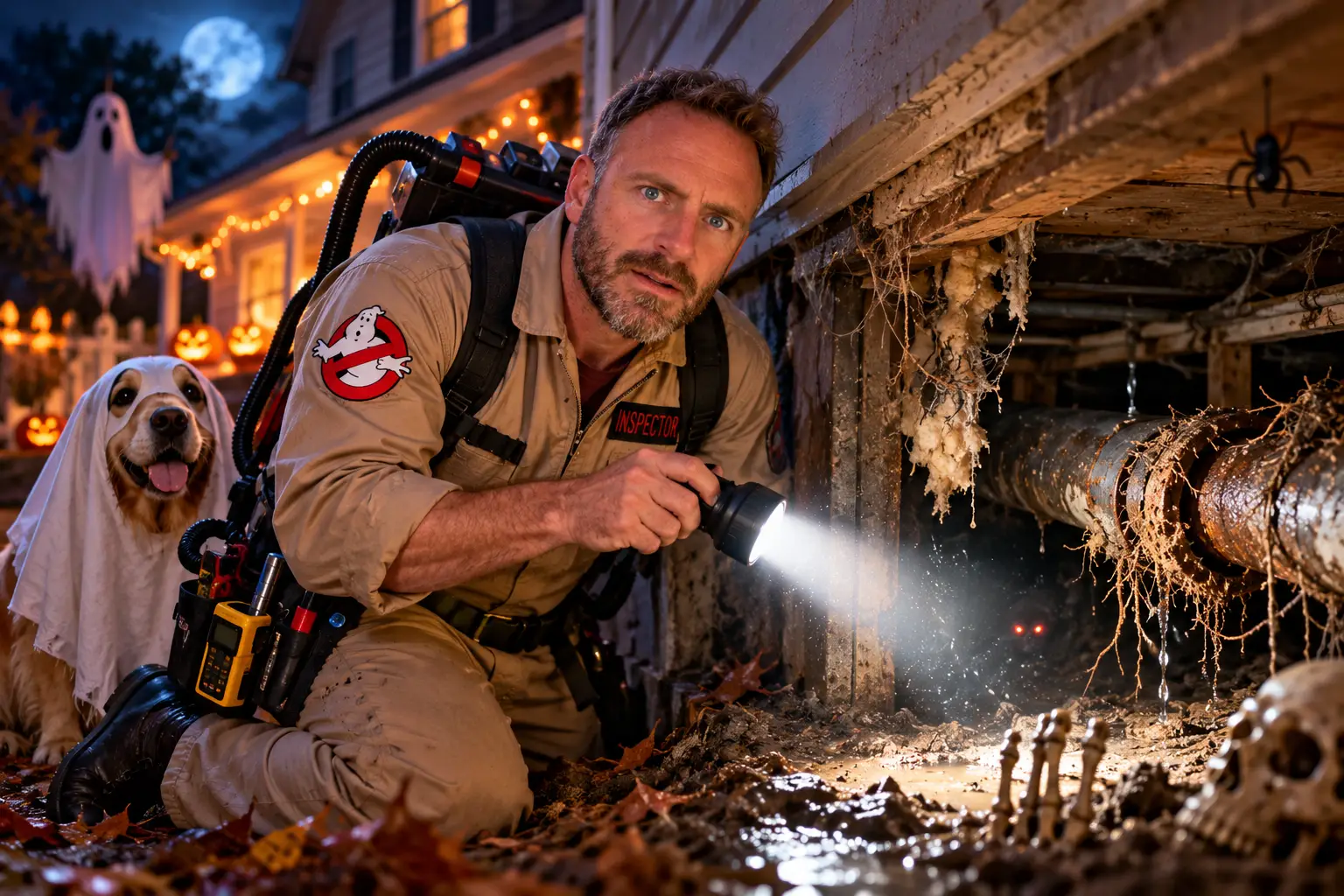
Forget haunted houses. The scariest thing you can find in a home is a $30,000 problem hiding behind freshly painted drywall.
It’s October in Portland, which means pumpkin patches, Halloween decorations, horror movies, and the annual return of that lovely Oregon weather that makes you question every decision you’ve ever made about living here. My fingers are crossed we don’t get rained on this Saturday!
But you know what’s scarier than a creepy clown standing at the end of a dark hallway? Finding out the beautiful home you just bought has a sewer line full of tree roots, a crawlspace that doubles as an indoor swimming pool, or electrical wiring installed by someone whose qualifications apparently consisted of watching three YouTube videos and owning a screwdriver.
I’ve been in real estate for over a decade, and I can tell you that some of the scariest things I’ve encountered haven’t been in haunted houses. They’ve been in perfectly normal-looking homes that buyers were ready to spend hundreds of thousands of dollars on. And here’s the really terrifying part. A lot of these homes looked absolutely fantastic!
So, in honor of spooky season, let’s talk about some real-life home inspection nightmares, why they happen, and why I will always recommend getting a home inspection, even if you’re buying a brand-new house or Grandma’s adorable little bungalow.
The New Construction Nightmare: Where the Hell Does the Poop Go?
Let’s start with one I’ve actually encountered, because this one is a special kind of stupid. Imagine buying a beautiful, brand-new home. Everything is shiny, the appliances have never been used, the floors are spotless, and the builder is proudly handing over the keys to your new dream house.
There’s just one tiny problem.
They forgot to connect the house’s sewer line to the community sewer main. Yep, you read that correctly.
The house had plumbing. It had toilets. It had sinks. It had all the things you’d expect in a home, except for one fairly important detail… somewhere for the wastewater and fecal matter to actually go! Now, I’m no plumber, but I’m pretty sure that’s a significant part of the whole indoor plumbing concept.
Imagine throwing a housewarming party, everyone enjoying a few beers and some questionable appetizers, and suddenly discovering that flushing the toilet is more of a suggestion than an actual functioning system. That’s not a housewarming party. That’s the opening scene of a horror movie.
And this is exactly why I tell people that new construction does not mean perfect construction. Builders make mistakes. Subcontractors make mistakes. Things get overlooked. Municipal inspections serve an important purpose, but they aren’t a substitute for having an independent inspector working specifically for you.
I’ve seen enough new construction issues to know that a brand-new house can have just as many surprises as an older one. They just come with newer paint.
The Sewer Scope: A Horror Movie You Really Don’t Want to Watch
Speaking of sewer lines, let’s talk about one of my favorite recommendations for buyers: getting a sewer scope.
If you’ve never had one done, a plumber or sewer inspection specialist runs a camera through the sewer line to see what’s happening inside. It’s basically a colonoscopy for your house, except the results can cost you considerably more than an uncomfortable afternoon.
And believe me, there’s some horrifying shit hiding down there. Tree roots growing through pipes, collapsed sections, offset joints, broken connections, and pipes that have apparently been collecting things they shouldn’t for decades.
One homebuyer’s inspection experience was where the house looked beautiful, but the inspections revealed a laundry list of problems, including roots in the sewer line, mold, water damage, scorched electrical wiring, and possible foundation issues.
That’s not an inspection report. That’s a damn Stephen King novel.
Here in the Portland metro area, we have plenty of older neighborhoods with mature trees, aging sewer infrastructure, and homes that have been around long enough to develop some interesting plumbing personalities. And while older sewer lines can be particularly vulnerable, newer homes aren’t automatically immune to installation problems or damage.
A standard home inspection generally doesn’t include running a camera through the underground sewer line. That’s a separate service, and one I regularly recommend. Spending a few hundred dollars to potentially uncover a repair costing thousands? That seems like a pretty reasonable investment to me.
The Crawlspace: Where Nightmares Go to Breed
If you’ve never crawled underneath a house in the Pacific Northwest, congratulations. You’re probably living a happier life than the rest of us. Crawlspaces can be some truly disgusting places.
You’ve got moisture, mud, spiders, rodents, insulation hanging down like something out of a haunted cave (usually because mice have made a nice little nest in it), and occasionally enough standing water to qualify as a neighborhood swimming pool.
And then there’s the smell. Oh, the smell!
But the really scary stuff isn’t necessarily the spiders or the occasional dead rodent. It’s what moisture can do to a home over time. Rotting floor joists, damaged subflooring, fungal growth, plumbing leaks, and foundation issues can all develop in places the average homeowner rarely, if ever, visits.
In Oregon, where it rains for what feels like nine consecutive months, moisture management is a big freaking deal. Improper grading, disconnected downspouts, inadequate crawlspace ventilation or moisture control, and leaking pipes can create problems that go unnoticed for years.
And here’s what makes it worse: sometimes the people living in the house have absolutely no idea there’s a problem. The floors look fine. The walls look fine. Everything seems perfectly normal. Meanwhile, underneath the house, Mother Nature is slowly eating your investment. That’s why having someone willing to get down there and investigate is so important.
Electrical Work by Someone Who Shouldn’t Be Allowed Near a Light Switch
You know what’s genuinely terrifying? Discovering that the previous homeowner apparently believed electrical codes were more of a friendly suggestion than actual safety requirements.
Home inspectors regularly uncover things like exposed wiring, overloaded circuits, improperly installed electrical panels, missing junction box covers, and wiring that looks like it was assembled during a drunken game of Operation.
And then there’s my personal favorite category: the DIY electrical enthusiast.
This is the guy who decided to finish the basement himself, watched a few videos, bought some wire at Home Depot, and figured he’d save a few bucks by skipping the electrician.
Twenty years later, the new buyer discovers a wiring situation that looks like a plate of spaghetti having a nervous breakdown.
Unlike a dripping faucet or a squeaky door, electrical problems can be serious safety hazards. We’re talking shocks, overheating, and potentially house fires.
Not exactly the kind of surprise you want when you’re settling in for a cozy October evening.
The Fresh Paint Cover-Up: Lipstick on a Very Expensive Pig
Here’s something buyers need to understand: just because a home looks beautiful doesn’t mean it’s healthy.
I’ve seen plenty of homes where the sellers have gone all out preparing the property for sale. Fresh paint, new flooring, updated fixtures, beautiful staging, and maybe a kitchen that looks like it belongs on HGTV.
And that’s great. Presentation matters.
But occasionally, cosmetic improvements can hide problems rather than solve them.
That freshly painted ceiling? Maybe it had a water stain from a roof leak.
The new flooring? Maybe it’s covering a damaged subfloor.
That suspiciously strong air freshener? Maybe somebody just really loves lavender. Or maybe they’re trying to cover up a smell that would make a sewer worker gag.
I’m not saying every seller is trying to hide something. Most aren’t.
But sometimes people make cosmetic repairs without understanding what’s causing the underlying problem.
They paint over a stain instead of fixing the leak. They replace a piece of drywall without addressing the moisture. They patch a crack without figuring out why it appeared.
And sometimes, they genuinely believe the problem has been fixed.
Unfortunately, water doesn’t give a shit about your new paint color.
The Roof That Looked Fine Until It Wasn’t
Let’s talk about another classic inspection horror story: the roof.
From the street, everything looks great. The shingles are there, nothing appears to be falling off, and the seller assures you they’ve never had a problem.
Wonderful.
Then the inspector gets up there and discovers deteriorated flashing, damaged shingles, questionable repairs, or signs that water has been finding its way into the attic.
Suddenly that charming little house has a very expensive hat problem.
And in Portland, roof issues are particularly important because our rainy season doesn’t exactly give you a lot of opportunities to ignore a leak.
A tiny opening around a vent or chimney might not seem like a big deal, but repeated water intrusion can damage insulation, drywall, sheathing, and framing.
What starts as a relatively inexpensive repair can turn into a much bigger project if it’s ignored long enough.
The scary part is that a homeowner might never notice anything until the damage has already spread.
Which brings me to the biggest lesson of this entire conversation.
Most Homeowners Don’t Fix Problems They Don’t Know Exist
This is something I tell buyers all the time, and I think it’s one of the most important things to understand about buying a home.
Most people aren’t deliberately hiding problems. They simply don’t know those problems exist.
Think about your own house for a minute.
When was the last time you crawled underneath it? Climbed into the attic? Had someone inspect your electrical panel? Ran a camera through your sewer line?
Exactly.
Most homeowners maintain their houses based on what they can see, hear, smell, or experience.
If the toilet flushes, they assume the plumbing is fine. If the lights turn on, the electrical system must be working. If there’s no water dripping from the ceiling, the roof must be doing its job.
And that’s a perfectly understandable way to live.
But houses are complicated systems, and things deteriorate over time. Sometimes slowly, sometimes suddenly, and sometimes without giving you any warning whatsoever.
That’s why a seller can honestly tell you they’ve never had a problem with something, only for an inspector to discover that the problem has been developing for years.
The seller isn’t necessarily lying.
They just didn’t know.
I Don’t Care If You’re Buying It From Grandma. Get the Damn Inspection.
I hear all kinds of reasons why buyers think they don’t need a home inspection.
“It’s brand-new construction.”
“The seller just remodeled everything.”
“My uncle is a contractor.”
“My grandma has lived there for 40 years and always took great care of it.”
That’s fantastic. I’m happy for Grandma.
Get the inspection anyway.
Grandma might have been the most meticulous homeowner in the history of homeownership, but unless she was regularly crawling around underneath the house with a moisture meter and inspecting the sewer line with a camera, there are things she probably didn’t know about.
And that brand-new home? Remember the sewer line that wasn’t connected?
Exactly.
An inspection isn’t about accusing the seller of being dishonest or assuming the builder is incompetent. It’s about understanding what you’re buying.
And here’s another important point: inspections aren’t just about finding reasons to walk away from a house.
They’re about identifying safety concerns, understanding future maintenance needs, budgeting for repairs, and sometimes negotiating with the seller to address significant issues before closing.
A home inspection also isn’t a guarantee that every problem will be found. It’s primarily a visual assessment of accessible components, which is why additional inspections like sewer scopes, radon testing, or specialized evaluations can make sense depending on the property.
You don’t need to panic because an inspector finds a loose toilet or a dripping faucet. Every house has issues, even new ones.
What matters is understanding the difference between a $150 repair and a $15,000 surprise.
Kevin’s Take: The Only Thing Scarier Than an Inspection Report Is Not Getting One
Look, I love Halloween. The decorations, the horror movies, the excuse to eat an unreasonable amount of candy and pretend it’s all for the kids.
But when it comes to buying real estate, I’d prefer to keep the horror stories fictional.
Buying a home is probably one of the largest financial decisions you’ll ever make. Skipping an inspection to save a few hundred dollars is a hell of a gamble when you consider what could be hiding behind the walls, underneath the floors, or buried in the yard.
And no, I’m not suggesting that every home is secretly falling apart. Most aren’t.
I’m saying that even a well-maintained home can have problems nobody knows about, and a little due diligence before closing can save you an enormous amount of money, frustration, and regret.
Whether you’re buying a 1920s Portland bungalow, a 1990s suburban home in Beaverton, or a brand-new house in Hillsboro, my advice is the same.
Get the inspection. Get the sewer scope. Ask questions. Understand what you’re buying.
Because the only thing worse than discovering something horrifying during a home inspection is discovering it three months after you’ve moved in, when the seller is long gone and the repair bill is entirely yours.
And if your toilet starts making strange noises in the middle of the night, hopefully it’s just the plumbing.
Not the ghost of the plumber who forgot to connect the damn sewer line.
Happy Halloween, Portland!


Join The Discussion