


So, you’ve decided to sell your house. Fantastic! I can help with this!
Then you start walking around looking at everything through the eyes of a buyer for the first time in 12 years.
That paint looks like shit.
When did that cabinet start doing that?
Why is there a crack there?
Jesus Christ, have we always had this much crap?
And suddenly a relatively simple plan to sell your house turns into a $93,000 renovation involving three contractors, a designer, six months of your life, and a kitchen faucet that costs more than your first car. Before you start swinging a sledgehammer because HGTV gave you a renovation boner, there’s a much more important question:
Should you renovate the damn thing at all?
My answer??? It depends.
I know! That’s fucking groundbreaking real estate advice. But it really does!
First: Is It Broken, or Is It Just Ugly?
This is probably the most important distinction. There’s a big difference between something that needs to be repaired and something that would simply be nice to update.
If your roof is leaking, the furnace sounds like it’s communicating with the dead, there’s water damage under the kitchen sink, or the deck railing moves six inches when you touch it…
Fix that shit.
Because if you don’t, the buyer is probably going to find it during their inspection anyway. And in the current market, they’re probably going to ask you to fix it, give them a credit, lower the price, sacrifice your firstborn, and leave the refrigerator.
Portland buyers have more leverage right now. They can afford to be pickier, and recent reporting on our market shows buyers are scrutinizing property condition and negotiating harder when they find problems. So deferred maintenance matters.
That doesn’t mean you have to repair everything. Sometimes a seller looks at me and basically says:
“Kevin, I don’t give a shit. I just want out.”
And you know what, fair enough!
There is absolutely a price where somebody will buy your house exactly the way it sits. You just have to understand that convenience has a price.
If fixing $15,000 worth of problems could increase your eventual net proceeds by $30,000, we should probably have that conversation before you hand somebody else $15,000 of your equity.
Repairs and Renovations Are Not the Same Thing
This is where sellers get themselves into trouble. Replacing rotted siding?
Repair.
Replacing perfectly functional siding because you don’t like the color anymore?
Renovation.
Fixing a leaking shower?
Repair.
Gut-remodeling the entire bathroom because you decided buyers can’t possibly survive without a floating vanity and matte-black fixtures?
Renovation.
One protects the value you already have. The other is a bet that spending money will create additional value. And like every bet, sometimes it works, and other times you just bought the next owner a really fucking nice kitchen.
The Small Shit Usually Wins
Most of the time, when somebody tells me they’re thinking about spending $75,000 renovating before selling, my first question is:
Why?
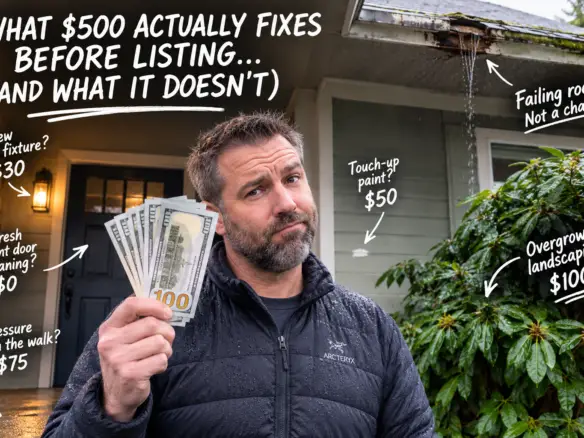
Because there are usually much easier wins. Fresh paint, replace fucked-up trim, fix holes and cracks. Deep clean everything. Pressure wash the exterior and clean up the landscaping. Replace a few dated light fixtures.
Fix obviously broken shit.
Get rid of approximately 63% of the crap you’ve accumulated over the last decade. Maybe replace some flooring if it’s particularly rough.
None of that is sexy.
Nobody is going to give you your own HGTV show called Kevin Made Me Paint My Fucking House.
But that’s usually where I’d rather see sellers spend their money.
NAR’s 2025 remodeling research actually found that the most common projects Realtors recommend before selling are things like painting and addressing the roof, rather than automatically gutting kitchens and bathrooms.
And that’s the point.
We’re preparing the house for market, not building your dream home six weeks before you move out of it.
But What About the Kitchen and Bathrooms?
Okay. This is where things get interesting. Kitchens and bathrooms absolutely matter!
They’re two of the rooms buyers pay the most attention to, and upgrades can make a home substantially more appealing.
But there’s a gigantic difference between an upgrade and a holy-shit-we-accidentally-spent-$147,000 renovation.
Nationally, NAR’s 2025 Remodeling Impact Report estimated that both a complete kitchen renovation and minor kitchen upgrade recovered about 60% of their cost at resale, while a bathroom renovation recovered about 50%.
Other Cost vs. Value research paints an even more interesting picture here in the PNW: smaller midrange kitchen remodels have historically performed significantly better than giant upscale renovations.
Translation?
More expensive doesn’t automatically mean more profitable.
Which brings us to the scenario where I actually might tell you to grab the sledgehammer.
When Spending $100K Actually Makes Sense
Let’s say your house, as it currently sits, is probably worth around $650,000. And it’s in a neighborhood where renovated homes are regularly selling for $800,000-$825,000.
Your kitchen looks like it hosted Thanksgiving dinner during the Reagan administration, the bathrooms are equally dated, but structurally the house is solid.
Now let’s say we determine you can renovate intelligently for somewhere around $50,000-$100,000.
And after studying the actual comparable sales, not your Zillow Zestimate, not your neighbor Steve, and definitely not whatever somebody on Facebook Marketplace told you, we have strong evidence that the finished house could realistically sell north of $800,000.
Now we’re having a very different conversation.
Because spending $75,000 to potentially create $150,000+ in additional value might make sense. If the comps support it.
Those five words matter more than anything else in this entire section. Because you don’t get to decide your house is worth $800,000 simply because you installed a $9,000 refrigerator and countertops quarried from the fucking moon.
The market decides.
Don’t Over-Improve the Neighborhood
This is another place people get into trouble.
If every beautifully renovated home around you tops out around $700,000, spending $150,000 trying to create an $850,000 house is probably a terrible fucking idea.
Congratulations. You now own the nicest house on the block. And you paid for upgrades the appraisal and buyers may never fully reward you for.
Renovations need to make sense relative to the property and the neighborhood.
A $20,000 kitchen refresh in a $550,000 house could be brilliant. A $125,000 chef’s kitchen in that same house might just mean the next owner gets an incredible Wolf range while you eat the depreciation.
And Then There’s the Current Portland Market
This part matters a lot right now. We’re not operating in the ridiculous seller’s market where somebody could list a garden shed with black mold for $725,000 and receive 19 offers by lunch.
Buyers have options. Inventory is higher. They’re negotiating, they’re looking at competing homes, and condition matters.
Recent Portland reporting reflects exactly that: properly priced, well-prepared homes can still move quickly, while overpriced or poorly prepared properties are more likely to sit and eventually face reductions.
That makes preparation important. But it also makes timing important.
If your renovation takes four months, what happens to the market during those four months?
What happens to mortgage rates?
What happens to inventory?
What happens if three competing renovated homes hit the market?
And what does carrying your house for another four months cost you?
Mortgage, taxes, insurance, utilities, maintenance, and probably your sanity.
Suddenly your $60,000 renovation isn’t really a $60,000 renovation anymore.
There’s a Cost to Waiting
This is the part that gets ignored in most renovation calculations.
Let’s say renovating adds an estimated $70,000 to your eventual net proceeds.
Sounds awesome. But it takes five months. During those five months, you spend another $18,000 carrying the property. You spend $7,000 more than expected because contractors discovered something behind a wall that looked like it belonged in The Last of Us. Then the market softens slightly.
Now that theoretical $70,000 gain starts shrinking pretty damn quickly. That’s why the calculation can’t simply be:
Renovation Cost vs. Higher Sale Price
It needs to be:
Renovation Cost + Carrying Cost + Risk + Time vs. Realistic Additional Net Proceeds
That’s a very different equation.
So What Would I Do?
For most sellers?
Do the small shit and get the house on the market.
Repair things that are actually broken. Handle obvious deferred maintenance. Paint where it needs paint. Clean the hell out of it. Declutter and improve curb appeal. Make the house feel cared for. Then price it correctly and let the market do its job.
I would rather see you spend $10,000 intelligently than $80,000 emotionally.
But there are absolutely situations where a larger renovation makes sense. If I can show you comparable sales proving that putting $50,000-$100,000 into your house could realistically create substantially more value than you’re spending, then fuck yes, let’s talk about doing it.
That’s not renovating because we think buyers might like it. That’s making an investment based on actual numbers. Big difference.
Kevin’s Take
There isn’t a universal answer to whether you should renovate before selling. Sorry, I know everybody wants the easy answer.
“Spend $37,422 and your house will magically be worth $100,000 more.”
Real estate doesn’t work like that.
Your house, your neighborhood, your competition, your price point, your timeline, and the current market all matter.
Sometimes the right answer is spending $500. Sometimes it’s spending $50,000. Sometimes it’s selling the bastard exactly the way it sits, taking a little less money, handing somebody the keys, and driving away while flipping the house off in the rearview mirror.
And honestly? There can be tremendous value in that too. The important thing is figuring out which improvements actually increase your net proceeds before you spend the money.
That’s a conversation I’d much rather have with a seller before they renovate than after they’ve spent $87,000 turning their perfectly functional kitchen into something that looks like a Restoration Hardware showroom.
Because once the money’s gone, I can’t un-fuck that decision.


Join The Discussion