
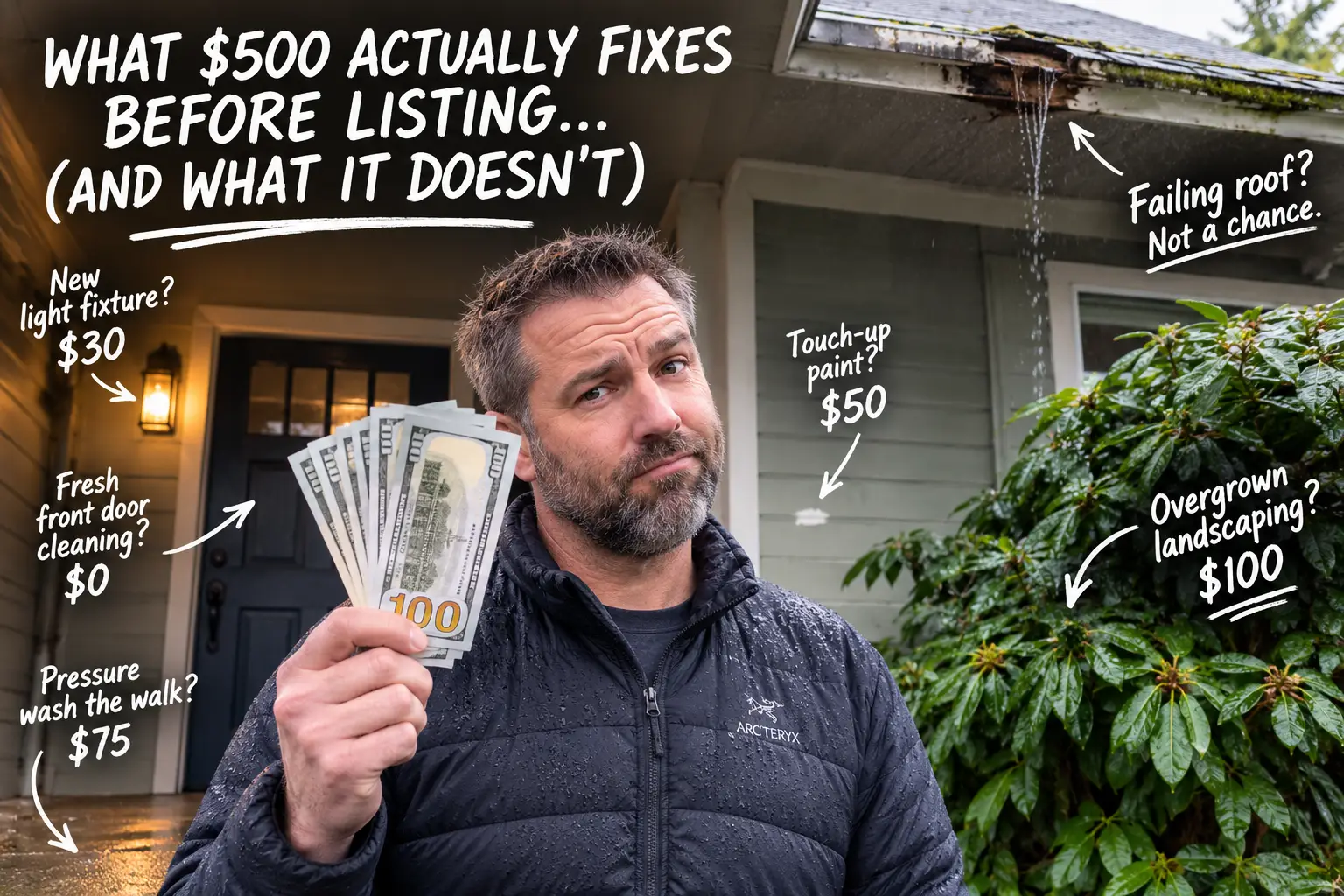
There’s this weird thing that happens when people decide to sell their house. Suddenly, every little thing they’ve ignored for the last seven years becomes an emergency.
That chipped baseboard? WE HAVE TO FIX IT.
The slightly dated bathroom light? NO BUYER WILL EVER LOVE US.
That one cabinet door that has been crooked since Obama was president? CALL A CONTRACTOR. WE’RE FUCKED.
Relax.
You probably don’t need to remodel your house before you sell it. In fact, I routinely talk sellers out of spending money because there are plenty of things you can dump $5,000, $10,000 or $30,000 into that aren’t going to come back to you when the house sells.
But here’s the interesting part: $500 spent in the right places can actually do a shitload of good.
Not because you’re adding $20,000 in appraised value. You’re not. You’re doing something arguably more important: removing the little distractions that make buyers start wondering what else you’ve neglected.
And in today’s Portland market, that’s a big deal.
$500 Can Fix “This House Feels Tired”
This is where a small budget absolutely kicks ass.
Walk into your house like you’ve never seen it before. Ignore the furniture. Ignore your memories. Ignore the fact that you know the weird stain on the ceiling came from the time your kid launched spaghetti across the room in 2019.
What does a buyer see?
Maybe it’s scuffed walls, dirty baseboards, yellowed caulk around the tub, mismatched light bulbs, a loose doorknob, overgrown bushes and a front porch covered in eight months of Oregon’s finest green slime.
None of these things individually kills a sale.
Together, though? They create a feeling.
Deferred maintenance.
That’s the phrase you don’t want bouncing around inside a buyer’s head.
A few hundred bucks can go a surprisingly long way toward changing that impression. Fresh caulk around the sinks and tubs. Touch-up paint where it actually needs it. New outlet and switch covers if yours look like hell. A couple modern light fixtures. Fresh bark dust. Trim the bushes. Replace the burned-out bulbs. Clean the gutters around the entry. Pressure wash the front walk.
You’re not remodeling the house. You’re making it look like someone gives a shit about it. And buyers notice that.
The $500 Front Door Test
If I only had a few hundred bucks to prepare a house for market, I’d put a disproportionate amount of attention on what happens between the driveway and the first 30 seconds inside the house.
Because that’s where the first impression happens.
And here in Portland, Mother Nature spends approximately nine months a year trying to turn every horizontal outdoor surface into a chia pet.
Clean that shit up.
Pressure wash the walkway. Sweep the porch. Knock down the cobwebs. Clean the exterior light fixtures. Trim whatever plant is attempting to consume your front door. Put down some fresh bark dust. Maybe add a couple inexpensive plants near the entry.
Then clean the actual front door.
It’s amazing how many sellers spend thousands preparing the inside while buyers stand outside waiting for their Realtor to open the lockbox staring directly at a filthy door covered in fingerprints, pollen and moss.
Guess what they’re doing while they’re standing there?
Looking at your dirty ass house bro!
Give them something nice to look at.
$500 Can Also Fix “What the Hell Is That?”
There are little things in houses that homeowners stop seeing because they’ve lived with them forever.
The loose toilet seat. The door that doesn’t latch. The faucet that drips. The cabinet knob that’s missing. The closet door that’s off the track. The cracked outlet cover.
The smoke detector hanging slightly off the ceiling because somebody changed the battery four years ago and apparently completing the remaining 8% of the project was simply too much to ask.
Fix those.
They’re cheap, they’re obvious and they make buyers wonder about things that aren’t cheap. That’s the important part.
A buyer sees a dripping faucet and doesn’t necessarily think, “Oh, that’s probably a $30 repair.”
They think:
“If they didn’t fix this, what else didn’t they fix?”
Now they’re looking harder. Suddenly they’re inspecting the windows. Looking under sinks. Staring at cracks. Wondering about the roof. Congratulations, your $30 faucet just turned your buyer into fucking Sherlock Holmes.
What $500 DOESN’T Fix
Here’s where sellers can get themselves into trouble.
Five hundred bucks is cosmetic triage money.
It isn’t make-the-house-magically-not-have-problems money.
It doesn’t fix a failing roof. It doesn’t replace a sewer line. It doesn’t make an old electrical panel younger. It doesn’t solve significant crawlspace moisture.
It doesn’t replace siding that’s rotting. It doesn’t fix a foundation problem. And it sure as hell doesn’t make those things disappear just because you installed a cute new light fixture from Home Depot.
Portland’s housing stock makes this especially important because we have plenty of older homes, mature trees, wet winters and the assortment of sewer, roof, drainage and moisture issues that come along with all of that. Those are the kinds of things inspectors and Portland-area buyers pay attention to.
If there’s a legitimate problem with the house, we need a strategy for it.
Sometimes that means fixing it. Sometimes that means getting a bid. Sometimes that means disclosing it and pricing accordingly. And sometimes it means doing absolutely nothing because spending $12,000 before listing won’t produce another $12,000 when you sell.
That’s where strategy matters.
Don’t Put Lipstick on a Sewer Line
This is probably my biggest issue with generic “10 Things to Do Before Selling!” advice.
Every house is different.
If you’ve got $500 available and the house is fundamentally in good shape, fantastic. Let’s make that money work its ass off improving presentation.
But if you have water coming into the crawlspace, I don’t give a shit what color you paint the front door. We need to deal with the thing that could actually affect the transaction. The same goes for replacing perfectly functional stuff just because it’s old.
Your furnace is 15 years old but works fine? Age doesn’t automatically mean you need a new furnace.
Your appliances aren’t stainless steel? Who cares?
Your countertops aren’t quartz? Believe it or not, civilization will continue.
A buyer may eventually change all of those things anyway. Spending thousands of dollars guessing what some hypothetical buyer might want is a fantastic way to remodel a house for someone else.
The Goal Isn’t to Make Your House Perfect
This is the part sellers sometimes struggle with. We’re not trying to make your home perfect. We’re trying to make it easy to buy.
Those aren’t the same thing. I want a buyer walking through your house thinking:
“This is clean.”
“This feels well maintained.”
“I could move in here.”
What I don’t want is:
“Why is that leaking?”
“Why doesn’t this door close?”
“Is that mold?”
“Holy shit, when was this roof installed?”
Every question creates friction. Some questions cost $15 to eliminate before listing. Others cost $15,000.
Our job is figuring out which ones are worth eliminating and which ones we’re better off addressing through pricing, disclosure or negotiation.
So Where Would I Spend the $500?
It depends entirely on the house, but generally I’m looking at cleaning, curb appeal and obvious cosmetic repairs first.
Give me $500 and I’d rather have a spotless house with a clean entry, trimmed landscaping, bright matching light bulbs, fresh caulk and all the stupid little broken things repaired than one room with a trendy new faucet surrounded by a house that looks neglected.
Because buyers aren’t walking around with an appraisal calculator assigning $183 of value to your new bathroom fixture.
They’re responding emotionally to the whole house.
Does it feel clean?
Does it feel cared for?
Does it feel like something they can own without immediately inheriting somebody else’s giant to-do list?
That’s what we’re buying with the $500. Confidence!
And in a market where Portland buyers have enough inventory to compare your home against several others, confidence matters. A well-prepared house doesn’t have to be the newest house on the block. It just needs to make more sense than the competition.
Kevin’s Take
Before you spend $10,000 getting your house ready to sell, let me walk through it with you. Seriously. I’ve talked sellers out of plenty of projects because I’d rather see you keep the damn money.
Sometimes $500 in the right places makes a surprisingly big difference. Sometimes we need to spend more. And sometimes the best move is to spend absolutely nothing and price the house accordingly.
The goal isn’t to make your house perfect.
It’s to spend the least amount of money necessary to put it in the strongest possible position when we hit the market.
That’s the strategy.