
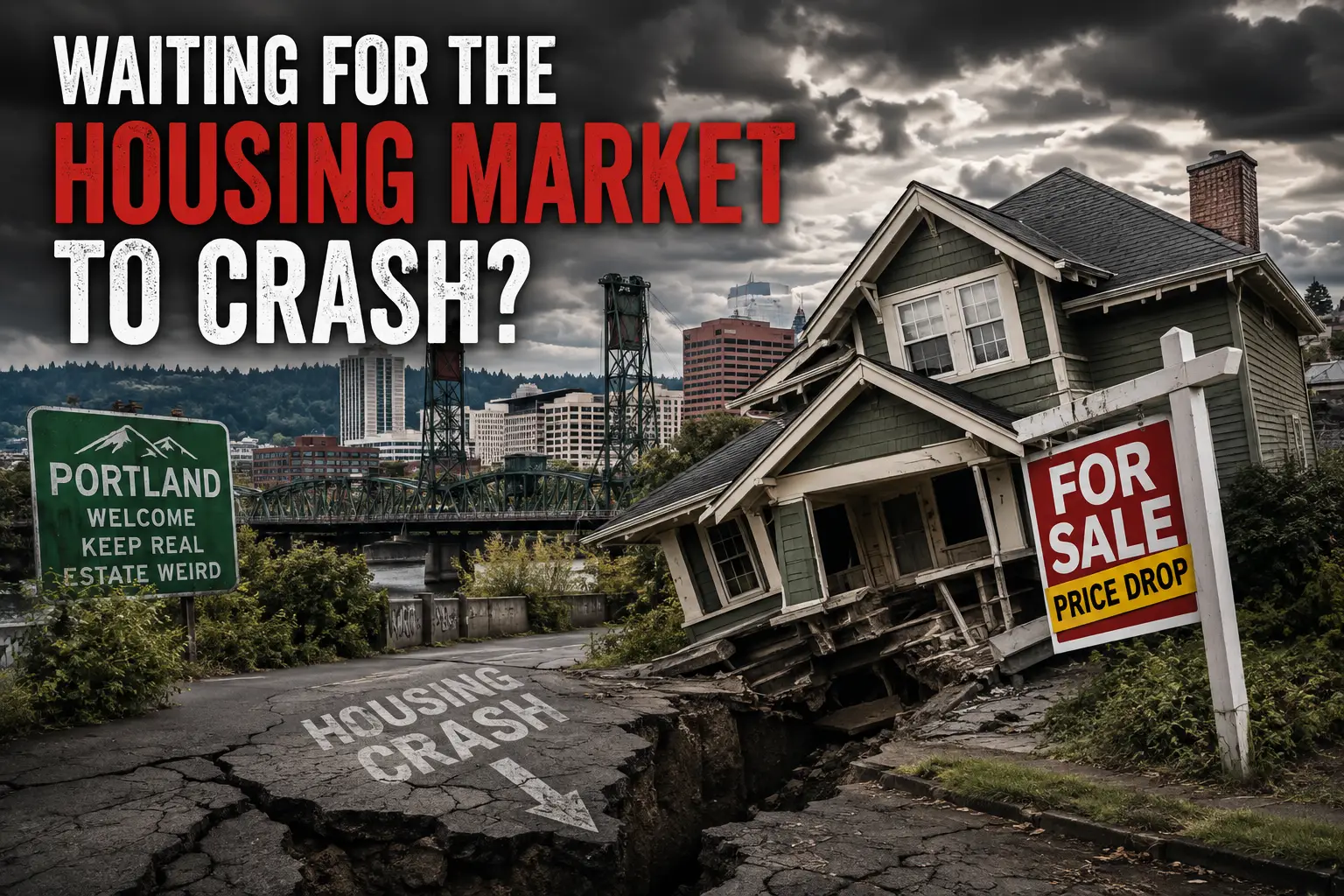
Every few months I hear some version of the same thing:
“I’m waiting for the market to crash.”
Usually it’s said with incredible confidence, like this person has a Bloomberg terminal in their basement and Jerome Powell personally texts them before making monetary policy decisions.
I get it. Nobody wants to buy a house and find out six months later that they bought at the absolute worst possible time. And if you lived through 2008, or you’ve watched approximately seventeen thousand TikToks predicting the next housing apocalypse, waiting can feel like the smart move.
But there’s one small problem.
The Portland housing market isn’t crashing.
Could prices decline? Absolutely. Could the economy go into a recession? Sure. Could interest rates move higher? For sure! Could they move lower? Also yes!
That’s the problem with trying to perfectly time a housing market. You don’t actually know which direction the next punch is coming from.
And neither does the guy on YouTube with the thumbnail of a house engulfed in flames and the words “IT’S FINALLY HAPPENING!!!” That’s just standard clickbait bullshit!
Myth #1: “Prices Have to Crash Eventually”
No, they don’t.
Housing prices aren’t a balloon that automatically pops because they’ve gotten expensive.
A true housing crash usually requires something much bigger underneath it: massive oversupply, widespread forced selling, serious unemployment, a credit crisis, or some combination of those things.
That’s not what we’re seeing in Portland right now.
July’s Portland Metro numbers showed a median sale price around $555,000, essentially unchanged from July 2025. Inventory was around 3.3 months, while closed sales were actually 8.1% higher than the year before. That’s not exactly the opening scene of The Big Short 2: Portlandia Edition.
What we actually have is a slower, more balanced market where buyers have significantly more negotiating power than they did a few years ago.
And frankly, that’s not a bad place to be as a buyer.
Myth #2: “I’ll Just Wait Until Prices Drop 20%”
Okay.
But what if they don’t?
This is the part people tend to ignore when they talk about waiting for a crash. Waiting isn’t free.
Let’s use the westside as an example.
Right now, renting a decent single-family house around Beaverton or Tigard can easily put you somewhere around $3,000 per month. Current rental data has Beaverton houses averaging roughly $2,800 and Tigard houses around $3,200, with larger homes frequently pushing beyond $3,000.
So let’s call it $3,000.
That’s $36,000 per year.
Stay there for three years and you’ve written checks totaling $108,000, assuming your landlord never raises your rent. Which is a BIG assumption!
And what do you own at the end? A really impressive collection of rent receipts.
Let’s Compare That With Buying
Let’s say instead you bought a similar home for $550,000. And if you don’t think you can buy a house that’s similar to what you’d find in a rental of $3,000 a month, call me immediately and let me prove it to you!
You put just 5% down, or $27,500, and finance the rest with a 30-year mortgage around today’s rate. As I’m writing this, the national average is right around the upper 6s, with Freddie Mac reporting 6.66% and daily mortgage-rate tracking around 6.75%. So using 6.75% for our example is pretty damn reasonable.
Now, your monthly cost of ownership will initially be higher than $3,000 once we include principal, interest, taxes, insurance and maintenance. I’m not going to bullshit you and pretend otherwise.
But there’s a gigantic difference between those two payments. Part of the homeowner’s payment comes back to them as equity.
On that $522,500 (we’re subtracting the 5% you put down) mortgage, after three years you’d have paid down roughly $18,000 of principal.
So between your original $27,500 down payment and mortgage paydown, you’ve already accumulated roughly $45,000 of equity, even if the home’s value doesn’t move one dollar, which is highly unlikely.
But historically, homes don’t stay at exactly the same price forever.
Let’s assume a relatively normal long-term appreciation rate of around 4% annually. I’m not promising that’s what Portland will do over the next three years. Nobody can promise you that, and if someone does, you should probably check whether they’re also selling magic beans.
At roughly 4% annual appreciation, that $550,000 home could be worth around $619,000 three years later.
Combine the appreciation with your original down payment and principal reduction and you’re sitting around $114,000 to $116,000 in gross equity.
The renter? Doesn’t have shit, other than a happy landlord who’s having their mortgage paid down.
Myth #3: “I’ll Buy When Interest Rates Come Down”
This one sounds perfectly logical.
The problem is that everyone else is thinking the exact same thing. Mortgage rates today are hovering around 6.7%. If rates eventually fall significantly, purchasing power improves.
But guess what happens when purchasing power improves? Buyers come back. Suddenly that house that’s been sitting for 47 days with one mediocre offer has six people walking through the open house on Saturday.
The seller who might give you $15,000 toward closing costs today isn’t nearly as interested in helping you when three other buyers want the house.
That’s what people forget about interest rates.
You don’t buy a house in a vacuum.
Lower rates are great, but they’re especially great when you’re the only person getting them. When everybody gets lower rates, demand will increase too.
I’d much rather negotiate aggressively on the price of the house and negotiate seller credits that can potentially buy down my interest rate than wait for the entire market to become more competitive.
And if rates drop significantly later? Refinance the f*cking thing.
You can refinance an interest rate. You can’t go back in time and buy the house before everybody else decided it was a good time to buy.
Myth #4: “2008 Is Going to Happen Again”
This is probably the biggest reason people expect a massive crash. They’ve seen it happen before. But 2008 wasn’t simply “houses got expensive and then prices fell.”
The housing and lending system itself was a shitshow.
People were getting mortgages they had absolutely no business qualifying for. Lending standards were dramatically different. There was massive speculation, bad loans were packaged into securities, adjustable-rate mortgages reset, foreclosures exploded and distressed inventory flooded the market.
That’s a very different scenario from Portland having 3.3 months of housing inventory and prices basically flat year over year.
Could we have a correction someday? Of course, I’m not the asshole optimist that says nothing bad will ever happen.
But “prices might decline” and “another 2008 is coming” are two completely different statements.
Here’s the Part Nobody Likes Hearing
You might wait three years and be right.
Maybe that $550,000 house becomes $500,000. Congratulations!!! You successfully waited out the market.
But if you spent $108,000 renting while waiting to save $50,000 on the purchase price, how much did you actually win?
That’s why the decision to buy a home shouldn’t simply be:
“Do I think prices will be lower next year?”
The better questions are whether you can comfortably afford the payment, whether you’re financially stable, whether you expect to stay in the home long enough for ownership to make sense, and whether buying fits your life.
Because your primary residence isn’t a stock you’re trying to day-trade. You f*cking live there dude!
The Portland Opportunity Nobody Talks About
The funny thing is that buyers waiting for the “perfect market” might actually be overlooking one of the biggest advantages of the market we have right now.
Sellers are negotiating because homes are sitting longer.
Price reductions are common. Buyers can ask for repairs. We can negotiate closing costs, and we can negotiate seller-paid rate buydowns.
We can actually conduct inspections without fourteen people standing behind us waving appraisal waivers and their firstborn children at the seller. That’s leverage, and leverage has value.
If mortgage rates eventually fall and buyers flood back into the Portland market, we will absolutely lose that negotiating power.
Nobody knows exactly what happens next. That’s precisely the point. Waiting for a market crash isn’t a strategy unless you actually know a crash is coming.
Otherwise, you’re just sitting on the sidelines hoping the future eventually gives you permission to live your life.
Kevin’s Take
I’m not going to tell someone they should buy a house simply because “real estate always goes up.” That’s bullshit. Sometimes it doesn’t. Everyone’s situation is different and their goals are different. However, long-term real estate does always go up, so there is that!
But I also wouldn’t spend years renting a house for $3,000 a month because some dude on YouTube has been predicting a 30% housing crash every six months since 2016.
If you can afford the house, you’re planning to stay for several years, and we can negotiate a good deal in today’s market, let’s look at the numbers. Maybe buying makes sense or maybe renting does. Either way I’ll give it to you straight.
But let’s make that decision with a calculator instead of a crystal fucking ball, ok!?